Everything on your land that is not the house
Shares one limit, usually ten per cent. Nobody adds it up because it arrives one piece at a time.
| The Walkthrough · Field Report | ||
|
File no.
017
|
Date
Wed 16 Sep 2026
|
Status
Two files
|
|
Subject of report
Rooftop and ground-mounted arrays — coverage placement
|
||
Good morning. Two solar files, four years apart, same county, and the difference between them had nothing to do with the panels.
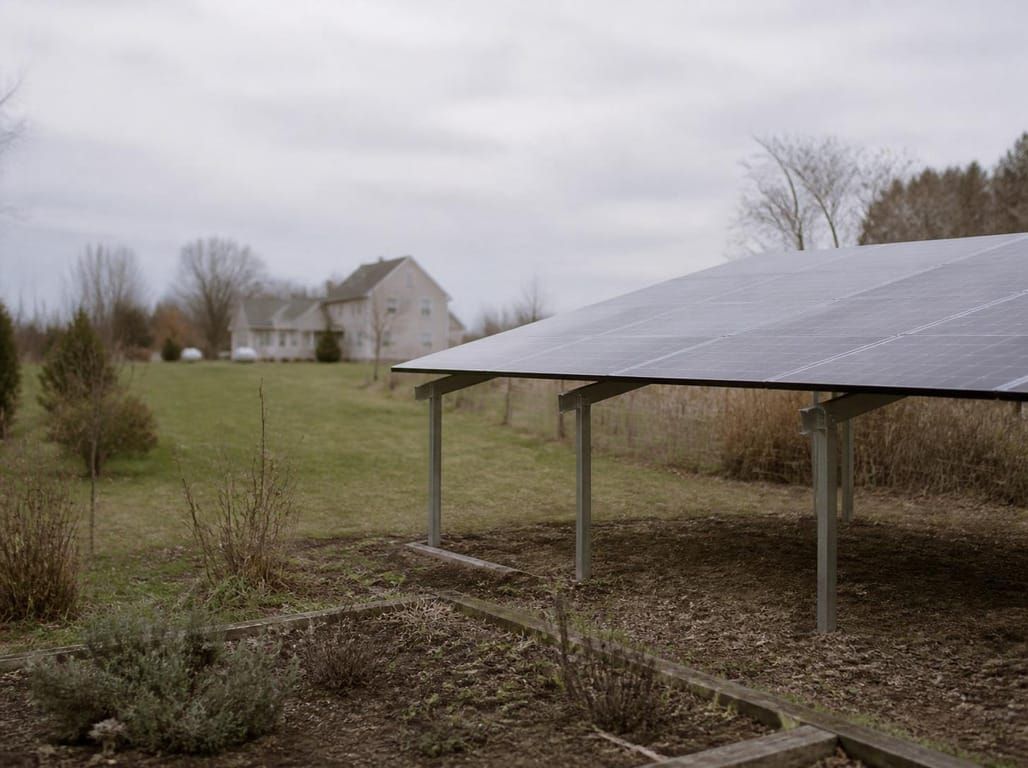
The first array was on the roof. Hail came through in June, took out three panels and a good deal of the shingle around them, and the claim was ordinary. The second array stood on a frame at the bottom of a garden in Hamburg, thirty feet from the house, and it was the same storm.
Those two households had roughly the same policy and got very different answers, because of where the frame was standing.
| Field 1 Where the array lives in the policy |
Panels bolted to the roof are treated as a permanent attachment to the house, in the same family as a skylight or a chimney. They sit under Coverage A and carry the dwelling limit behind them.
Panels on a frame in the garden are a detached structure. They sit under Coverage B, which on most policies is set at ten per cent of the dwelling limit, and that ten per cent is not per structure. It is the whole budget for everything detached that you own.
| My Coverage B, 10% of 211,000 | 21,100 |
| A seven kilowatt array, roughly | 21,000–28,000 |
A ground-mounted system of ordinary size can take up the whole of that limit on its own, and the shed, the fence and the detached garage are meant to be in there with it.
|
Note in margin
Thirty feet of garden decided which section of the policy applied. |
| Field 2 What else is in there with them |
If you have no solar and were about to stop reading, this is the part that applies to you anyway.
Coverage B holds everything on the property that is not the house: the detached garage, the shed, the fence that people are always surprised by, a pool and whatever surrounds it, a workshop, a barn, a gate, the posts holding up a carport. All of it draws on the same ten per cent.
Nobody adds these up, because they arrive one at a time over twenty years. A fence goes in one summer, a shed the next, the garage was always there. Each one on its own is small against the limit and the total is not, and the total is what applies when a storm takes the same corner of the property twice.
Work out what it would cost to rebuild everything on your land that is not the house. Then look at what ten per cent of your dwelling limit comes to. Those two figures are supposed to be in the same neighbourhood.
| Field 3 The cost nobody counts twice |
Roofs come off every twenty to thirty years in this climate, and sooner if hail finds you. When a roof with panels on it needs replacing, the array has to be taken down, stored somewhere, and put back afterwards, which is a separate trade and a separate bill.
Whether that bill lands on you depends on why the roof is being replaced. Tied to a covered claim, removal and reinstallation generally goes in the estimate with everything else. Replacing an old roof because it is old is not a claim, and the removal is yours.
I will add something from my side of it. An adjuster who has not written a solar file before will underestimate that line, not from bad faith but because it is not a number anybody can arrive at by looking. Taking an array down and putting it back is specialist work priced accordingly, and it does not resemble the rest of a roofing estimate. If you are ever handed an estimate with panels on the roof, that is the line to check first.
| Field 4 If you do not own them |
Somewhere between a sixth and a fifth of residential systems are leased or run on a power purchase agreement, which means the solar company owns the equipment and you are buying what comes out of it.
Your policy does not cover equipment you do not own. Theirs is meant to. What remains yours is the roof underneath, so if a leased panel comes loose in a storm and takes shingle with it, the roof is your claim and the panel is theirs, and the two conversations happen with different companies on different timescales while the rain carries on.
The lease also survives you selling the house, which is a subject for another letter and possibly a longer one.
| Scope Three questions, in writing |
|
I went looking for a plain public guide to send you with this and could not find one worth the link. Almost everything readable on the subject is published by somebody selling panels or somebody selling policies, which does not make it wrong and does mean the omissions are not accidental. Your own carrier, in writing, is the better source here.
| Rates of record | ||
| Fed funds target | 3.50–3.75% | decision at two o'clock |
| 30-year mortgage | 6.76% | third weekly rise |
| 15-year mortgage | 6.09% | 5.50% a year ago |
| Inflation, 12 mo to July | 3.4% | core 2.5% |
Freddie Mac PMMS, 10 Sep 2026. Federal Reserve, 29 Jul. BLS, 12 Aug. The committee has been sitting since yesterday and reports this afternoon.
| Remarks Adjuster's note |
The household in Hamburg were not careless. They read their policy when the panels went in, saw that solar was covered, and stopped reading at the word covered. The section it was covered under was three pages further on.
Almost none of what I have written about these past four weeks involved a hidden clause or anybody being dishonest. It was usually a true sentence sitting in the policy, answering a slightly different question from the one the household had in mind when they read it.
I have not put panels on this house and have thought about it twice. If you have an array, roof or ground, owned or leased, I would like to hear what your carrier said when you told them, and whether anybody raised the dwelling limit without being asked.
|
Signed
Rita Nowak
|
Standing instruction
Read the policy before you need it.
|
|
THE WALKTHROUGH · BUFFALO, N.Y. · SIX MORNINGS A WEEK Nothing here is insurance, legal or financial advice. I am a former claims adjuster, not an agent, a lawyer or a solar installer. Coverage placement, percentages and endorsements differ by policy, carrier and state. Ask yours in writing. |