Coverage A on your declarations page
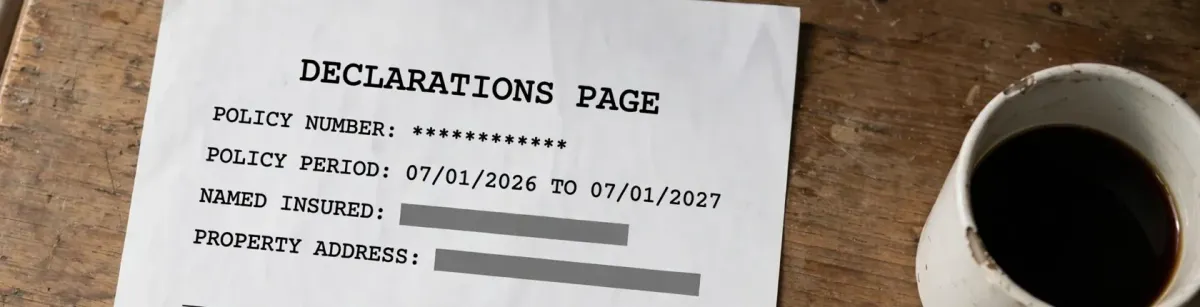
Mine says 2019. I have not done anything about it.
My name is Rita Nowak. This is the first of these, so — briefly, who I am.
For thirty years I was a field claims adjuster in Buffalo. I was the person who arrives after the fire or the burst pipe, walks the house with a tape measure, writes down what is damaged, and tells you the number. Fires, ice dams, wind, water. A few catastrophe deployments to Florida and the Gulf. I left staff work in 2023 and still take a couple of files a month, mostly to keep my hand in.
I am not an agent, a lawyer or a financial adviser, and I am not going to tell you what to buy. What I have is thirty years on the other end of the file — the order things get decided in, which line gets checked first, where the argument actually happens. Almost none of that is written down anywhere.
This lands six mornings a week. It is short. It is about the paperwork you already have rather than the decisions you might make later. And at least once a week, the thing costing money will turn out to be mine.
If you reply to this — one line is plenty — I will know you are real, and so will the mail system, which genuinely helps these arrive. Tell me where you are reading from, or nothing in particular. I read what comes in.
Now, today.
Two years, and still nothing
I pulled my own homeowners declarations page on Sunday. I was looking for something else. There it was on the first page, second block down: dwelling limit, and a figure that has not moved since 2019.
I spent thirty years telling other people what their houses were worth after a fire. I have said out loud, in other people's kitchens, that this is the most common problem in the country right now. Twice this year. And my own number is six years old.
That is roughly what this letter is going to be. Half what I know from the other end of the file, half what I have not got around to.
You have heard someone tell you to review your policy. Probably an agent, probably at renewal. I am not going to do that, because it is useless advice on its own — review it against what?
The useful part is narrower. There is one number, and there is a specific reason it sits still while everything around it moves.
Why it happens to careful people
Your policy renews itself. The premium goes up a bit, because premiums do, and the increase is small enough that you look at it, decide it is irritating, and put the envelope down. Nothing on that notice tells you what it would now cost to rebuild the house.
Those are two different numbers and they have been moving apart. The Insurance Information Institute put the rise in property replacement costs — materials and labour — at about 55% between 2019 and 2022, which it noted was close to four times the change in the Consumer Price Index over the same stretch. Building costs have kept climbing since.
Coverage limits do not do that on their own. Here in New York, the Department of Financial Services has published guidance noting that under Insurance Law § 3425 an insurer generally cannot unilaterally change your coverage limits during the required three-year policy period, and that inflation guard — the endorsement that nudges your limit up each year — is a separate thing you agree to. That is a protection, and I am glad it exists. It also means that if you do not have that endorsement, there is nobody whose job it is to move the number for you. Not your agent. Not your carrier. Nobody.
Mine, evidently, is not moving.
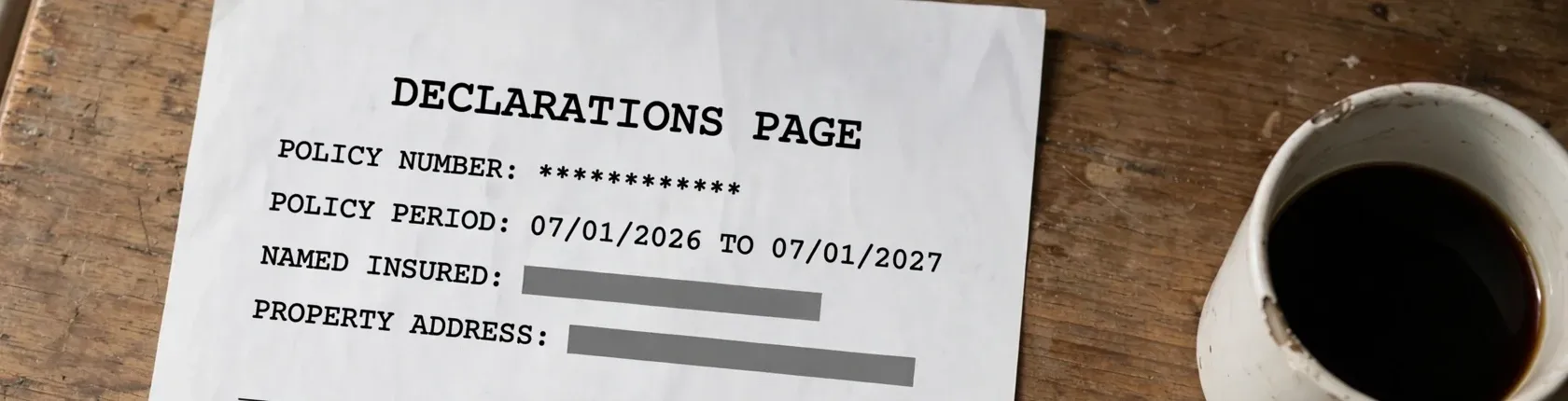
The dwelling limit is Coverage A on the declarations page. It is the amount available to rebuild the structure, not the contents and not the land. Other structures, personal property and loss of use are usually set as percentages of it. So when Coverage A is stale, three other numbers are stale too.
That last part is the piece people miss.
|
Colorado, December 2021 After the Marshall Fire — close to a thousand homes and businesses gone — the state's Division of Insurance opened 951 of the affected policies to see what they actually said. Seventy-six of them had guaranteed replacement cost: the kind that pays what the rebuild actually costs. Eight per cent. The rest had a number, and the number was the ceiling. |
I am not telling you to buy anything. I do not know your house, your carrier, or what your paperwork says.
What it actually costs
Here is the thing I did do on Sunday. It took four minutes.
|
Four minutes, today Find your declarations page. It is the first page of the packet, the one with the numbers on it, usually the only page anyone keeps. Look for Coverage A, dwelling. Write down the figure and the year of the policy. Put it somewhere you will find it again. That is the whole task. Not fixing it. Just knowing the number, so that when you do call, you are having a five-minute conversation instead of a twenty-minute one. |
August is the right month for it, at least around here. In February, when the ice backs up at the roof edge and the water comes down through the ceiling, this is an emergency and nobody picks up the phone. Today it is an errand.
I have not made the call. I am going to tell you that every week until I do, which I suspect is the only mechanism that will work on me.
|
2019
The year my dwelling limit was last set. Yours is on page one of your policy.
|
The money meter
| Fed funds target | 3.50–3.75%, held on 29 July. Three of the twelve voters wanted it higher. Federal Reserve, 29 Jul 2026 |
| Inflation | +3.4% over the twelve months to July. Core +2.5%. Shelter +3.2%. BLS, 12 Aug 2026 |
| 30-year mortgage | 6.67%, down from 6.69% the week before. Freddie Mac PMMS, 13 Aug 2026 |
| Gas, national average | $4.06 a gallon. AAA, 17 Aug 2026 |
Where I stand today
I think Coverage A is the highest-stakes number in most people's paperwork, and almost nobody looks at it — including someone who spent thirty years looking at other people's. Whether that means you should ring your carrier this week, I do not know. It depends how far off you are, and you cannot know that until you look.
Tomorrow: two words in your policy that decide how a roof gets paid for, and why the difference is larger than most people expect.
Read the policy before you need it. — Rita
Written under a pen name. The person writing it is real; the name is not.
Nothing here is insurance, legal or financial advice. Policy forms vary by carrier and by state — check your own declarations page.