350 degrees, and the drive in your safe
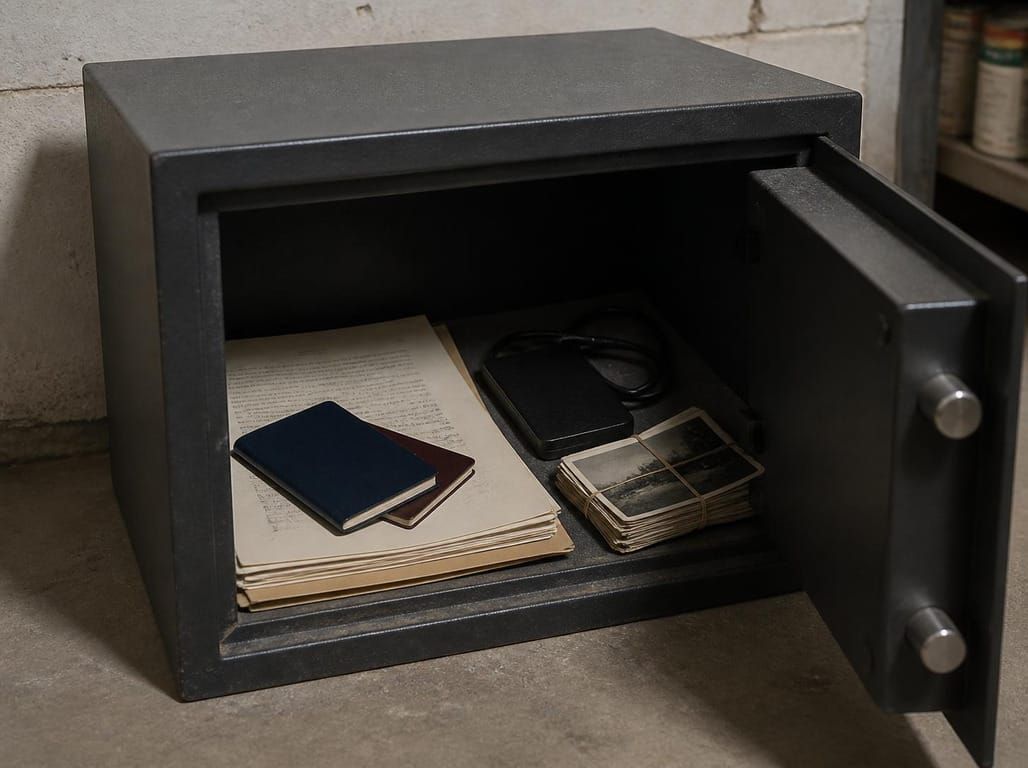
Paper survives that. A hard drive gives up at a third of it, and both are in the same box.
| The Walkthrough · Field Report | ||
|
File no.
018
|
Date
Thu 17 Sep 2026
|
Status
Partly wrong
|
|
Subject of report
UL 72 fire classes — what a residential safe is rated to protect
|
||
Good morning. A reader in Ohio wrote to tell me I have been making heavy weather of all this, and he put it well enough that I want to quote him.
|
Everything that matters is in a fireproof safe in the basement. Deed, policy, passports, the backup drive, my wife's photographs. Bolted down. So most of what you write about is somebody else's problem, not mine. — Reader, Ohio |
He is more than half right, and he is ahead of most households by a wide margin. The safe is bolted down, which is the thing people skip, and everything is in one place, which is the other thing people skip.
The part that is not right is sitting in there with the deed, and it is his wife's photographs.
If you have no safe and were about to file this one under other people's problems, skip to Field 3. That part is about the limits on what you own, and it applies whether your things are behind a lock or in a drawer.
| Field 1 The number on the sticker |
There is a standard behind the word fireproof, and it is more specific than the word suggests. Underwriters Laboratories tests a safe by putting it in a furnace at roughly seventeen hundred degrees and measuring what happens inside the box. The rating describes the interior, not the fire.
Three classes come out of that test, and they are not grades of quality. They are three different jobs.
| Class 350 | 350°F | paper records |
| Class 150 | 150°F | film, photographic media |
| Class 125 | 125°F | digital media |
Three hundred and fifty is not an arbitrary line. Paper begins to brown somewhere around three hundred and eighty-seven degrees and takes flame at four hundred and fifty-one, so a box that holds its interior under three fifty for an hour will hand you back a readable deed.
A hard drive does not wait for three fifty. Platters warp and lubricants give up well before a hundred and fifty, which is why there is a separate class for them, set at a hundred and twenty-five and carrying a humidity limit as well.
|
Note in margin
The deed and the drive sat in the same box for the same hour, and only one of them came out readable. |
| Field 2 Which one is in your basement |
It will almost certainly be Class 350, which is the common residential rating, it is what the word fireproof means on a box sold in a hardware shop, and the label is accurate. Nobody has misled the reader in Ohio. The safe does precisely the job it was tested to do.
The difficulty is that a household puts the deed and the photographs and the backup drive into the same box, because they are all the things you would hate to lose, and the box was only ever sorting them by temperature.
Class 125 boxes exist and they are dearer, heavier and smaller inside. The rating was originally worked out for floppy disks, which tells you how long this problem has been solved by people who knew about it.
| Field 3 The part that applies to everybody |
Here is the part that has nothing to do with fire, and nothing to do with owning a safe either.
Your policy sets a ceiling on certain categories of possession regardless of where you keep them. Coins and bullion sit under two hundred dollars. Jewellery carries fifteen hundred on theft. Those figures follow the object, not the container, so a locked box changes the odds of a burglar reaching the thing without changing what you are paid once he has.
Most households have something in one of those categories and have never looked at the ceiling over it. The ceiling moves through scheduling, which is a telephone call to your carrier rather than a trip to the hardware shop, and it is the single most useful thing in this letter for anybody reading it without a safe in the basement.
| Scope Two minutes, on your knees |
|
| Rates of record | ||
| Fed funds target | 3.75–4.00% | raised 16 Sep, 12–0 |
| 30-year mortgage | 6.76% | new reading at noon |
| 15-year mortgage | 6.09% | 5.50% a year ago |
| Inflation, 12 mo to July | 3.4% | core 2.5% |
Federal Reserve, 16 Sep 2026 — first increase since 2023, with projections pointing to the possibility of another this year. Freddie Mac PMMS, 10 Sep. BLS, 12 Aug. Fire classes from UL 72.
| Remarks Adjuster's note |
I have opened two safes in burned houses. Both times the paper inside was fine, warm and faintly brown at the edges, and both times somebody asked about the photographs before they asked about anything else.
The reader in Ohio has done more than most people reading this, and the correction he needs costs nothing and takes an evening. I would rather write about him than about somebody with nothing in a drawer.
Tomorrow is Friday, so it will carry whatever I got wrong this week, and there is a candidate already.
|
Signed
Rita Nowak
|
Standing instruction
Read the policy before you need it.
|
|
THE WALKTHROUGH · BUFFALO, N.Y. · SIX MORNINGS A WEEK Nothing here is insurance, legal or financial advice. I am a former claims adjuster, not an agent, a lawyer or a financial adviser. Safe ratings, policy forms and special limits differ by product, carrier and state. Check the label and your own document. |